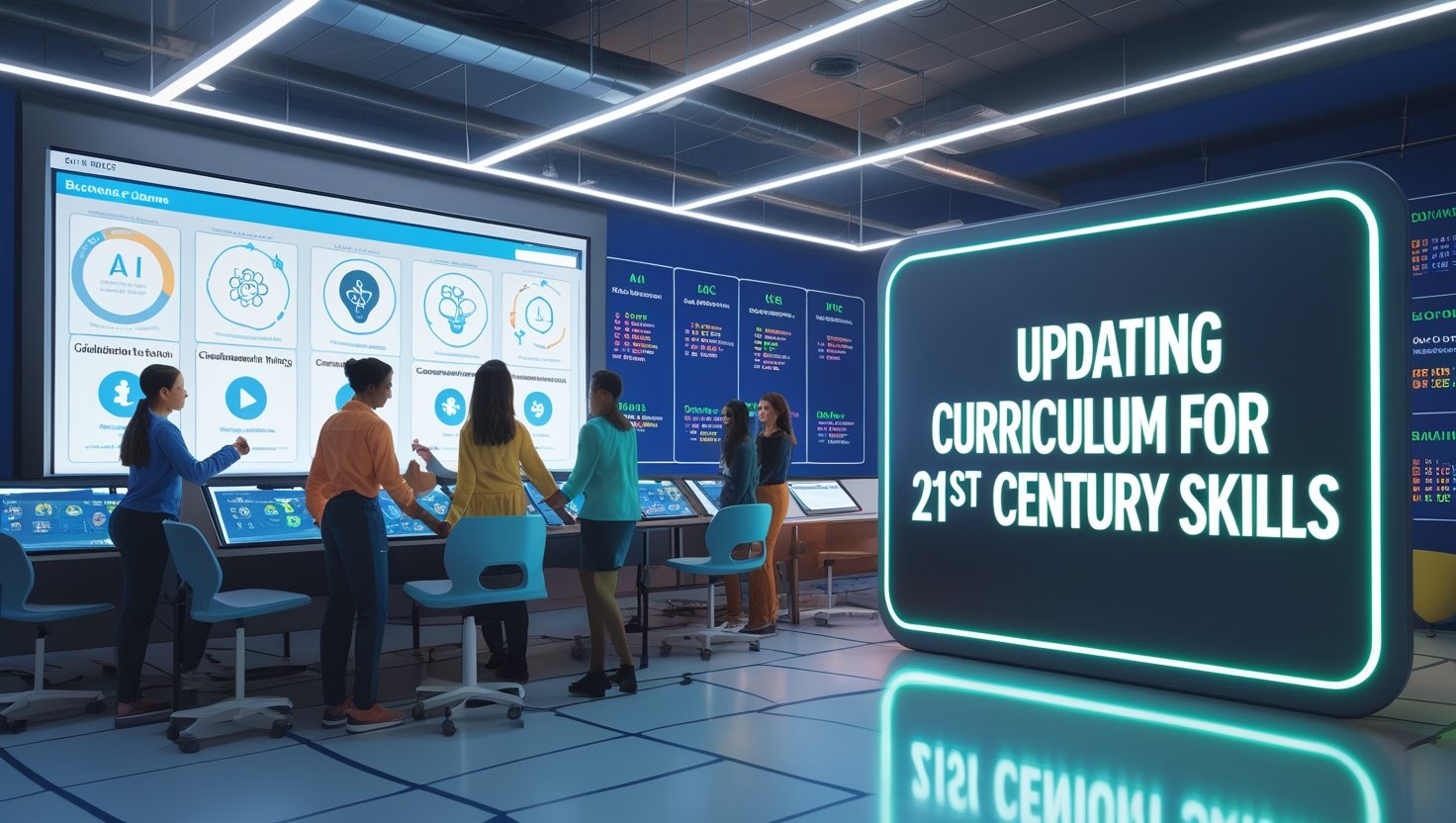
Today’s time is changing very rapidly, where technology, communication, and global competition have become a part of every field. The traditional curriculum, which earlier relied only on rote learning and an exam-based system, is now outdated. Such a curriculum does not provide students with the skills that prepare them to face the challenges of real life. Therefore, it has become very important to revise the education system and include new 21st-century skills such as critical thinking, collaboration, creativity, and digital literacy. Unless we update our syllabus and teaching styles, we cannot give our students the foundation they need for a successful career and a meaningful life.
Every student needs not just theoretical knowledge but also practical thinking and communication skills, which they can apply effectively in the modern world. Updating the curriculum is a progressive step that has an impact not only within the classroom but at every level of society. When students learn in new ways, elements such as decision-making, leadership, and teamwork develop within them. Today, every country and every institute should try to prepare their students for the 21st century so that they are not only capable of getting a job, but also become capable of doing something new in the world with new ideas.
Understanding 21st Century Skills:
21st-century skills are those competencies that are essential for any student to be successful in today’s modern and digital world. These include the most important skills: critical thinking, communication, collaboration, creativity, and digital literacy. Apart from traditional academics, these skills are also useful in practical life, where every person faces new problems every day and searches for logical solutions to them. Critical thinking means understanding things deeply, analyzing them, and making your own decisions without any bias. Communication skill means explaining your point easily and clearly, and understanding others’ points.
Collaboration means working together as a team and giving respect to everyone’s opinion. Creativity means thinking in a new way, getting new ideas, and implementing them. Digital literacy is also a basic requirement today, where every student should know how to use technology. Learning all these skills has become not just a choice but a necessity. If schools and colleges do not make these a part of their syllabus, then students face a lot of difficulty in the practical world. Therefore, the education system should integrate these skills with the core subjects so that every student can be balanced and future-ready.
The Role of Critical Thinking in Student Success:
Critical thinking is a skill that every student needs at every stage of life. It is not just an academic ability but also a way to live life. When a student faces a difficult question or challenge, learning by crying is not enough; there is a need to think and make a decision. Critical thinking means to analyse any situation, understand the facts, keep opinions and emotions aside, and find a solution using only logic. When this skill develops in students, they show excellence in every field, be it science, business, or the arts.
In today’s jobs, employers also prefer people who are critical thinkers, who can think of new ideas, solve problems independently, and can adapt quickly. This skill also improves the academic performance of students because when they learn any topic by understanding it, their concepts become clear, and they remember things for a long time. In schools, if teachers use discussion-based learning, open-ended questions, and real-life case studies, then this skill starts developing naturally in students. Critical thinking is not just a skill, but a foundation on which every other skill has a strong base. Without this skill, education becomes just a theory.
Building Collaboration into the Classroom:
In today’s time, when almost everything is done through teamwork, collaboration skills have become essential for every student. Collaboration means that students come together to exchange ideas, listen to each other, handle disagreements with respect, and ultimately achieve a common goal. Collaboration in the classroom is not just an activity but can be a powerful tool for learning if implemented properly. When students participate in group projects, peer discussions, and team-based learning, their communication skills, patience, and leadership qualities improve.
Often, when teachers do group work, students just divide the work, but real collaboration happens when each student actively contributes and finds a better solution with each other’s help. Collaboration develops a sense of responsibility in students because they know that their work will impact the outcome of the entire group. This skill also prepares them for future jobs where teamwork is very important.
If teachers make the class environment inclusive and respectful, give every student a chance to speak, and promote a feedback culture, then collaboration becomes natural. This skill is not just limited to the classroom but also has an impact on students’ social lives and career success. Today’s modern curriculum can be successful only when collaboration is made its core part.
Integrating Skills Across Subjects and Activities:
21st-century skills such as critical thinking and collaboration should not be limited to just one subject but should be part of every subject and classroom activity. When these skills are cross-curricular, students naturally adopt them and learn them in every situation. For example, if students are given a group experiment in a science class, they are learning collaboration. If they have to debate a topic in an English class, they are using both critical thinking and communication.
Teachers should create a little space within each lesson where students can show their thinking, analysis, and teamwork. It is not necessary that there should be a separate subject for these skills; rather, they can be integrated into every subject easily. Real-world problem solving in maths, role-play in social studies, and creative group work in the arts are such examples.
If the curriculum is made flexible, teachers can easily plan activities where students think independently and work as a team. This kind of teaching takes them out of boring theory and makes them active learners. The practical use of these skills prepares students for the real world, where they should not just have knowledge but also know the way to use that knowledge better. The goal of the curriculum should not be just content delivery, but holistic development.
Conclusion:
Today’s students are tomorrow’s leaders, innovators, and professionals, so they need not just traditional knowledge but also skills that will help them succeed in the 21st-century world. Critical thinking and collaboration are not just fancy terms but real-life skills without which excellence in any field is difficult. When students look at everything logically and work as a team to achieve better results, they become confident and responsible individuals.
Updating the curriculum is not a luxury but a necessity. Every school, every teacher, and every education policymaker needs to understand that without new skills, students can pass by just memorizing theory but fail in the test of life. Unless we connect education with real life, we will not be able to prepare students for the challenges that await them.
A future-ready learner is one who not only has bookish knowledge but also thinks of new ideas, works with others, considers every challenge as an opportunity, and finds a better solution. To create such students, we must make revolutionary changes to our curriculum. This task is certainly difficult, but its impact will be deep and long-lasting.
FAQs:
1. What are 21st-century skills, and why are they important in today’s education?
21st-century skills include critical thinking, communication, collaboration, creativity, and digital literacy. These are essential for helping students succeed in a rapidly changing, technology-driven world. Traditional education often focuses only on memorization, but these modern skills prepare students for real-life challenges, future careers, and responsible citizenship.
2. How does critical thinking benefit students inside and outside the classroom?
Critical thinking helps students analyze information deeply, solve problems logically, and make unbiased decisions. It improves academic performance by promoting real understanding over rote learning. Outside the classroom, it helps students make sound life choices, adapt to challenges, and become better professionals, leaders, and thinkers.
3. Why is collaboration necessary in modern classrooms?
Collaboration teaches students how to work in teams, share ideas, respect others’ views, and achieve common goals. These skills are vital for both academic success and workplace readiness. Group activities, peer discussions, and shared projects enhance communication and leadership skills, making students more socially and professionally competent.
4. How can 21st-century skills be integrated into all school subjects?
Instead of teaching these skills separately, schools can embed them into every subject and activity. For example, group science experiments build collaboration, debates in language classes enhance critical thinking, and problem-solving tasks in math develop logic. Cross-curricular integration makes learning more meaningful and prepares students for real-world applications.
5. What is the impact of updating the curriculum to include these modern skills?
Updating the curriculum ensures that students are future-ready, not just exam-ready. It develops well-rounded individuals who can think creatively, work with others, and use technology effectively. A modern curriculum supports lifelong success by equipping students with both academic knowledge and the practical skills needed for life and work in the 21st century.
Top of Form
Bottom of Form